Status Quo for 214 UNICAL Law Students: What the Federal High Court Decided, and What It Did Not
The Federal High Court in Abuja has ordered the University of Calabar to restore 214 law students' access to lectures and the portal until their suit is decided. It is an interlocutory order, not a ruling on whether their admission to Law was valid. A look at what was decided and what the reports do not yet say.
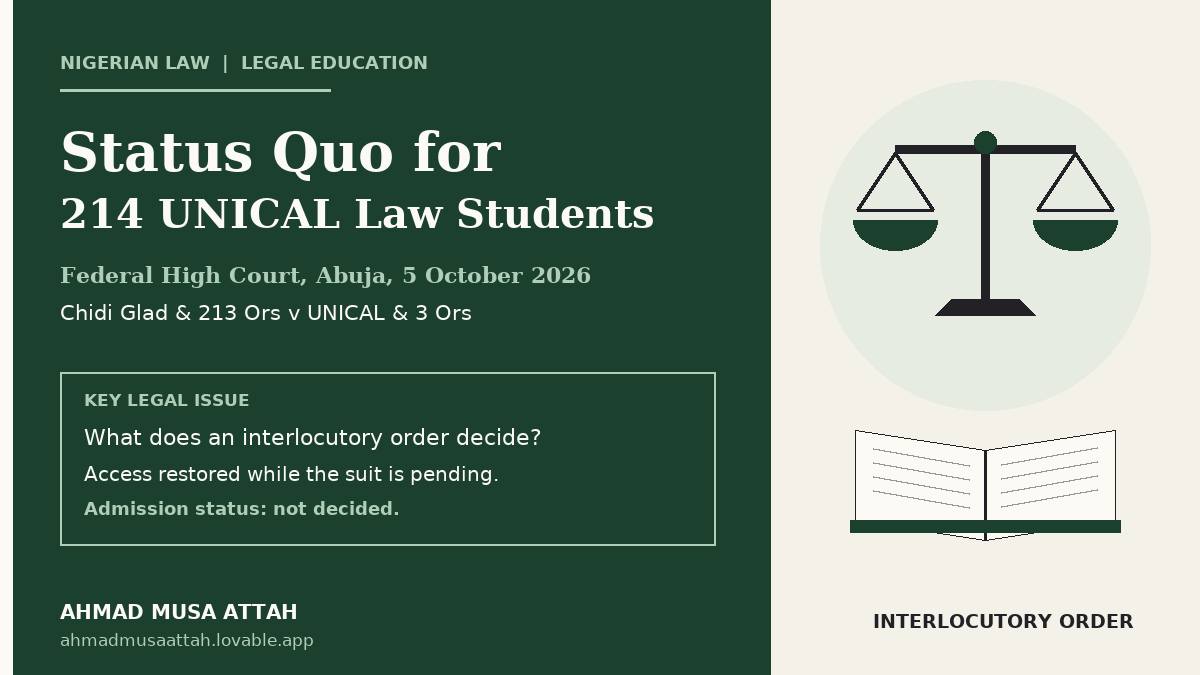
On Monday, 5 October 2026, the Federal High Court in Abuja ordered the University of Calabar (UNICAL) to give 214 second-year law students access to lectures, the student portal and other academic facilities until their suit is decided. Premium Times and TheNigeriaLawyer report that Abdulmalik J granted an interlocutory injunction directing the parties to maintain the status quo, and Premium Times reports that she adjourned the case to 25 November 2026 for hearing. The order is not a ruling that the students were validly admitted to Law. This article explains what the court did, what it did not decide, and why that difference matters.
What happened?
The suit is Chidi Glad and 213 Others v University of Calabar and 3 Others, marked FHC/ABJ/CS/1825/2026 in earlier reports, started by originating summons on 12 August 2026. As reported, the defendants are UNICAL, its Vice-Chancellor Prof. Offiong Offiong, its Registrar and President Bola Tinubu. At Monday's sitting the students were represented by Bernard Okpi, appearing with four other lawyers, and the university and the other defendants by Jonas Abuo and Akiba-Eyo Veronica. After hearing both sides, the judge granted the interlocutory orders the students had asked for in a bench ruling, that is, a ruling given orally in court. Premium Times says its account of the order draws on a statement by the students' lawyer. I have not seen the order itself.
Background: how the dispute began
According to the reports, on 5 August 2026 the Vice-Chancellor told a meeting at the university that only 221 of the 435 second-year LL.B students had been officially admitted into the Law programme and that the other 214 had entered the Faculty of Law from other departments. The university announced that the 214 would be returned to the departments where they were first admitted, and said that if they stayed in Law under their existing admission status they would not be eligible for admission to the Nigerian Law School. The claimants allege that their result portals were deactivated straight away.
The students dispute the university's position. They say UNICAL admitted them into Law, accepted their fees, registered them for Law courses and let them sit examinations and move through the programme, and that it later directed them to undergo JAMB regularisation, which they say they completed after paying the required fees. They also say they were not given a chance to defend themselves before the 5 August decision. These are the parties' claims, not findings of the court.
The reliefs the students are reported to seek include N5 billion in general damages, a perpetual injunction against restricting their portal access or taking other adverse action against them as Law students, and an order directing the President to exercise supervisory powers over the university's management.
The motion and the arguments on Monday
Alongside the main suit, the students filed a motion on notice for temporary protection while the case is pending. It asks the court to order the university to restore and maintain access to the result portals, course registration portals and learning platforms, and to restrain adverse academic or administrative action against them.
At the hearing, the defendants' lawyer told the court that his clients had been served but had not filed a response because the Vice-Chancellor and the Registrar had travelled out of the country. He said he had filed only a conditional memorandum of appearance and asked for an adjournment. The students' lawyer opposed this. He argued that the defendants were served on 24 August 2026 and had used up the 30 days allowed for a response, and he asked the court to proceed. In the alternative, he asked that any adjournment come on terms, namely N2 million in costs and leave for the students to move their motion. These are arguments by counsel, not holdings of the court.
What the court decided
On the reports, the court granted the interlocutory injunction the students sought. It ordered the parties to maintain the status quo and directed the university to give the 214 students unrestricted access to lectures, the students' portal and other academic facilities until the main suit is decided. Premium Times reports that the case was adjourned to 25 November 2026 for hearing.
The reports I found do not set out the judge's reasoning. They also do not say how the court dealt with the request for an adjournment or the argument about the 30-day period, so nobody should treat either point as decided.
What a status quo order is, and what it is not
This section is general background, not drawn from the reports, so check it against the order and the court's rules before relying on it. An order is interlocutory when it is made in the course of a case, before final judgment. An injunction at that stage is meant to preserve the position of the parties so that the final decision is not made pointless. The court is not deciding who is right.
Some outlets call this an interim order. In Nigerian practice an interim order usually lasts only until a motion on notice has been heard, while an interlocutory injunction lasts until the suit is decided. The reports describe the second kind, since the order is said to run until the main suit is determined, but the order itself would settle it.
A conditional memorandum of appearance is usually entered so that a defendant can still raise objections, for example about jurisdiction or procedure, before taking further steps. The reports do not say what, if anything, the university intends to challenge.
Why it matters
For law students, the case is a clear example of two different questions that are easy to blur: what the court can order to protect people's position while a case is pending, and what it finally decides about their rights. The order restores access. It does not confirm that the students were validly admitted to Law, and it does not decide whether they are eligible for the Nigerian Law School. Some headlines say the court ordered UNICAL to admit the students, but the reports of the order describe something narrower, namely restoring access and keeping the position as it was.
For lawyers, the reports suggest the court heard and granted the motion even though the defendants had not filed a response, and the reasons are not reported. The questions left for trial, as the reports frame them, include whether a Vice-Chancellor can unilaterally set aside admissions and JAMB regularisation approvals granted under a predecessor, and whether the students should have been heard first. Those are matters for the court to decide on the evidence.
Limits and open questions
The scope of this order should not be overstated. It binds the parties to this suit, it is a first-instance decision, and it is not a final judgment. I did not find a published response from UNICAL to the order, and I did not find the order itself or any law report citation. The hearing date of 25 November comes from one outlet. One outlet reported the order as made in Calabar by a different judge, but Premium Times and TheNigeriaLawyer both report Abuja and Abdulmalik J, and the suit number carries the Abuja prefix.
Key takeaway
A status quo order protects the position while a case runs. It does not decide the merits. For now the 214 students can go back to lectures and their portal, while the questions of whether their admission to Law was valid and what that means for the Nigerian Law School remain for the court.
Sources
Premium Times, Court grants reprieve to 214 students ejected from UNICAL's Law faculty (5 October 2026): https://www.premiumtimesng.com/news/top-news/914741-court-grants-reprieve-to-214-students-ejected-from-unicals-law-faculty.html
TheNigeriaLawyer, "Restore Their Access To Lectures, Portal And Academic Facilities": Court Orders UNICAL To Admit 214 Law Students Pending Suit (5 October 2026): https://thenigerialawyer.com/restore-their-access-to-lectures-portal-and-academic-facilities-court-orders-unical-to-admit-214-law-students-pending-suit/
TheNigeriaLawyer, 214 UNICAL Law Students Sue University, VC, Tinubu Over Removal From Faculty, Portal Lockout (August 2026): https://thenigerialawyer.com/214-unical-law-students-sue-university-vc-tinubu-over-removal-from-faculty-portal-lockout-seek-reinstatement-%E2%82%A65bn-damages/
Premium Times via allAfrica, Unical Students File N5bn Suit Challenging Removal From Law Faculty (20 August 2026): https://allafrica.com/stories/202608200210.html
Political Economist, 214 UNICAL students file N5bn suit challenging removal from Law faculty (August 2026, suit number and filing date): https://politicaleconomistng.com/214-unical-students-file-n5bn-suit-challenging-removal-from-law-faculty/
Sahara Reporters, 214 UNICAL Students Sue University, Tinubu Over Removal From Faculty Of Law, Seek N5Billion In Damages (20 August 2026): https://saharareporters.com/2026/08/20/214-unical-students-sue-university-tinubu-over-removal-faculty-law-seek-n5billion
Note: the order itself was not available for review. This article is based on press reports, party names are as reported, and no law report citation has been verified. The section on status quo orders is general background.
This article is written for educational purposes as part of my legal studies. It reflects my own reading of the law and does not constitute legal advice.